Every competitive Valorant player eventually wants the same thing: a clean look back at every rank they've ever hit. Peak Diamond two acts ago, the Plat grind before that, the Silver days you'd rather forget. The catch is that Riot scatters that history across the client instead of handing you one timeline — and a lot of what people repeat about it online is wrong.
This guide covers exactly what rank history Valorant keeps, where to find it, and how to turn it into something you can show.

Does Valorant show your full rank history?
Valorant does not keep a scrollable, game-by-game record of your competitive rank inside the client. The Career tab's Match History shows only roughly your last ten matches — you can see the exact RR you gained or lost on each post-game screen and in that recent list, but older games roll off and there's no built-in log of every ranked match you've ever played. The "20 matches" figure people quote is a third-party tracker's window, not the in-client view. What Riot does preserve permanently is your standing for each Act, surfaced through the Act Rank badge. So the honest answer: a full match-by-match rank history isn't something the Valorant client exposes — but your peak rank per act is saved, and that's the part most players actually care about when they ask the question.

How to see your rank for every past act
Riot saves your competitive result for each Act and locks it into your Career tab. Open Career and your Act Rank badge shows your latest Act; a "previous act" control lets you step back through the earlier Acts you've played. Riot's own wording is that your prior Act Rank is "saved and locked in your Career tab," and that you can "review past Act Rank info" there. That's the real in-client way to see rank history across acts — not a per-game log, but a per-act peak record that doesn't vanish. Each badge stands for one Act's competitive performance, so flipping back through them is the closest thing to a rank-history timeline Riot gives you. Vouchant rebuilds that same per-act journey straight from your live account, so the whole climb sits on one page instead of behind a toggle.

What the triangles on the Act Rank badge mean
The Act Rank badge is a pyramid of small triangles, and each triangle is one ranked-match win. The color and size of a triangle encode the rank you held at the moment you won that game — win a match that promotes you to Diamond 2 and you earn a Diamond 2 triangle. As you keep winning, higher-rank wins slowly replace the lower ones, so the badge always displays your best competitive games rather than your average performance. The triangle at the very top represents your single highest ranked win — what Riot calls your "proven skill." Reading the badge is therefore reading a compressed story of how high you climbed that Act: a handful of your strongest wins, ranked tier by tier, rather than a record of every game you queued. It rewards peaks, not consistency, which is why one big upset win can define your whole Act.

How your Act Rank is decided: peak, not average
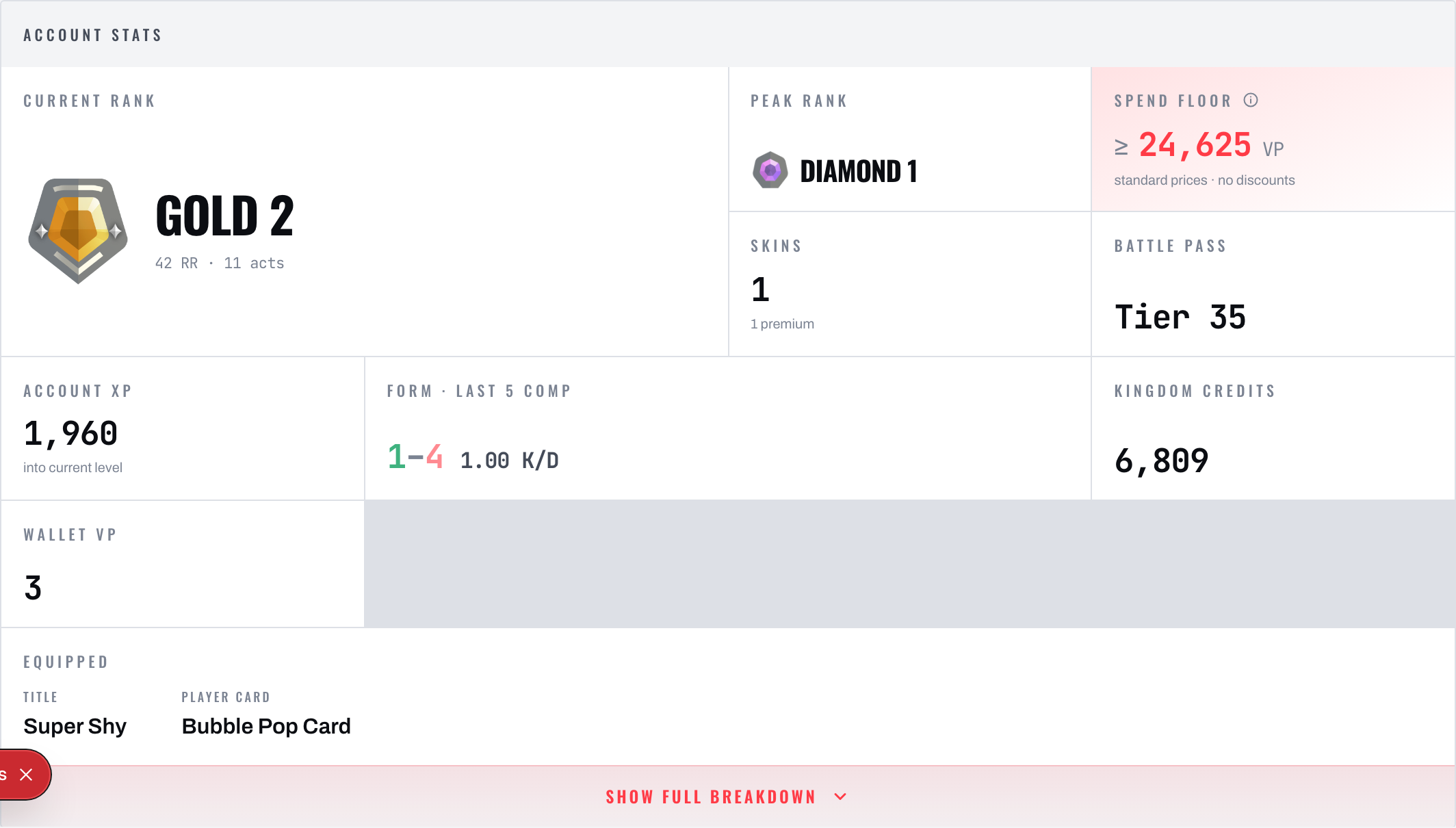
Your Act Rank is set by your highest ranked win, not your average or your final rank of the act. Riot's example is blunt: a player who spends most of an Act in Gold but lands a single win while sitting in Diamond 1 walks away with a Diamond Act Rank. The badge shows off your top nine ranked wins, and the "proven skill" tier it displays is specifically your ninth-best win — Riot's way of asking you to prove you can win at that level more than once. To earn an Act Rank badge at all (and qualify for ranked rewards) you need at least nine competitive wins in the Act, and the badge is only awarded once the Act ends. That's why your true ceiling — your peak rank — is the number worth tracking, and the stat Vouchant pulls and verifies front and center.
Why your rank never drops when you stop playing
Valorant has no visible rank decay. If you hit Immortal and then don't queue for a month, you will not slip to Ascendant — your displayed tier and RR stay put. After 14 days without a competitive game Riot only hides your rank from your card; a single match brings it right back. The thing that does quietly drift during a long break is your MMR (Matchmaking Rating) — the hidden number Riot uses to place you in games, which is never shown to players in any form. That's the distinction people get wrong constantly: RR (Rank Rating) is the visible value on your account and on trackers, while MMR is the invisible engine behind matchmaking. The closest you can get to reading your MMR is eyeballing the average rank of your lobbies. So your saved rank history reflects RR and peak tiers — clean, permanent milestones, not something inactivity erases.

Episodes, Acts, and Seasons: getting the terminology right
If you're hunting "rank history by episode" and the labels feel off, that's because Riot changed the calendar. Through 2024, Valorant ran on Episodes — each about six months, split into three two-month Acts. Starting in 2025 Riot replaced that with a year-long Season containing six two-month Acts, so mid-2026 sits inside Season 2026 (Act 3 wrapping in late June, with the next Act right behind it). Your old Episode-era Act Rank badges still describe the same thing: one peak-rank result per two-month Act. When you read or share a rank history now, the unit that matters is the Act — that's the window Riot grades, badges, and locks. Knowing the current terminology also helps when you compare your climb against a friend's, since "Episode 7 Act 2" and "Season 2026 Act 1" are just two naming systems for the same two-month competitive blocks.
How to check another player's rank history — and prove your own
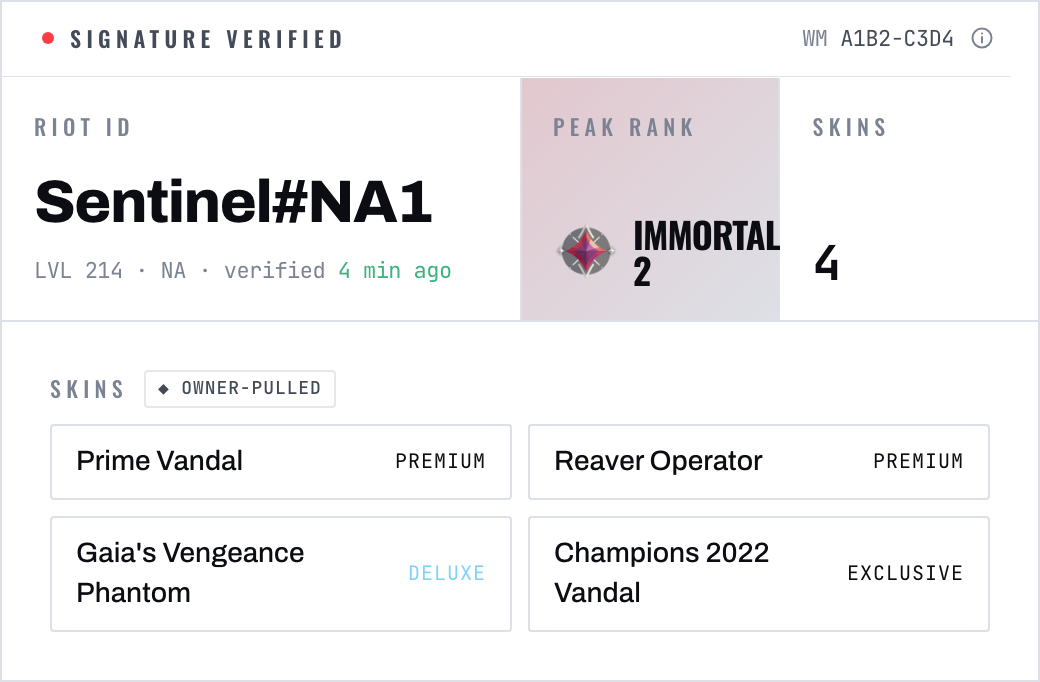
You can't look up someone else's rank history from inside your own client — Riot keeps that view private. Third-party trackers fill the gap by pulling competitive and match data through Riot's API when a Riot ID is entered, then compiling it into a profile. The important limit: Riot's API is gated and not an open feed of every player's data — a player generally has to opt in to share, so trackers can't reliably surface a stranger's full history, and what they do show can lag or break. That's the real problem when you want to prove your rank rather than just glance at it. Vouchant solves the proof side: you log in on Riot's own page, it reads your live competitive standing — current rank, peak rank, and your act-by-act archive — and signs the result into a page anyone can trust. Pair it with your verified inventory showcase for the full account picture.
The bottom line
Riot keeps your rank history as a chain of per-act peaks in the Career tab, not as a game-by-game log — and there's no decay erasing it. To read your own climb, step back through your Act Rank badges; to prove it to anyone else, pull it verified. Get a signed snapshot of your current rank, peak rank, and full act history at vouchant.space — one minute, no password shared, straight from Riot's systems.