If someone asks to see your Valorant skins, a screenshot is the fastest answer - and the easiest one to question. Crops hide context, images can be edited, and old captures go stale the moment your collection changes.
This guide explains how to make a Valorant inventory showcase that feels credible without handing anyone your password or relying on editable images.
What is the safest way to showcase a Valorant inventory?
The safest Valorant inventory showcase is a shareable proof page, not a folder of screenshots. A proof page should be generated from your live inventory, label when the data was checked, and make edits obvious through a signature or verification badge. That matters because the viewer is not just asking what skins you claim to own; they are asking whether the page still reflects the real account. A good showcase also avoids credential sharing. Riot's RSO documentation describes OAuth-style authorization as the pattern that lets players grant access to game information without sharing a password, and the Valorant developer policy says personal data should require player opt-in. In practice, the safe path is simple: authenticate on Riot's side, choose what becomes visible, share a revocable link, and keep private account details off the public page afterward.

Why screenshots are weak proof for Valorant skins
A Valorant screenshot is useful for quick context, but it is weak proof because it is just pixels. A viewer cannot tell whether the image was captured today, whether the Riot ID belongs to the same player, whether the collection tab was edited, or whether important status details were cropped away. Video helps, but it is still bulky, noisy, and hard to verify later in a Discord thread. The better standard is a page where the inventory data, rank, estimated VP spend, and restriction status are tied together at the time of verification. That does not make the collection more impressive by itself; it makes the claim easier to trust. Screenshots still work for casual style sharing, loadout comparisons, or quick reactions. If someone asks for proof, a signed showcase gives them fresher context and fewer reasons to doubt what they are seeing.

What details should a Valorant inventory showcase include?
A complete Valorant inventory showcase should include the fields people actually ask about: Riot ID, region, account level, current or peak rank, owned skins, estimated VP spend, and any live restriction check the tool can safely expose. The collection itself should separate paid-looking skins from earned items such as battle pass, event, or contract rewards, because a raw skin count can mislead. The page should also show when the data was verified, which fields came from Riot-linked data, and which numbers are estimates rather than exact receipts. For privacy, avoid exposing email addresses, login history, payment details, saved devices, or anything that would help someone impersonate the owner. A useful showcase answers the collection question while keeping sensitive account information out of the public view, and it should be readable even if the viewer opens it on mobile.

How Riot Sign On keeps inventory verification safer
Riot Sign On matters because a verifier should not ask for your Riot password directly. Riot describes RSO as a way for third parties to request access by redirecting players to Riot's login flow, using OAuth2 so players can authorize access without sharing their password. Riot's Valorant developer policy also says Valorant apps that handle personal data must request opt-in, and Riot's account-security guidance points players toward stronger protection like MFA. For a showcase, that means the safety checklist is straightforward: the login happens on Riot-controlled pages, the app explains what data becomes visible, the shared page reveals only what the owner chose to display, and the link can be turned off later. Anything asking for credentials outside that flow deserves skepticism, especially if it cannot clearly explain why it needs each requested permission.
How Vouchant turns an inventory into a shareable proof
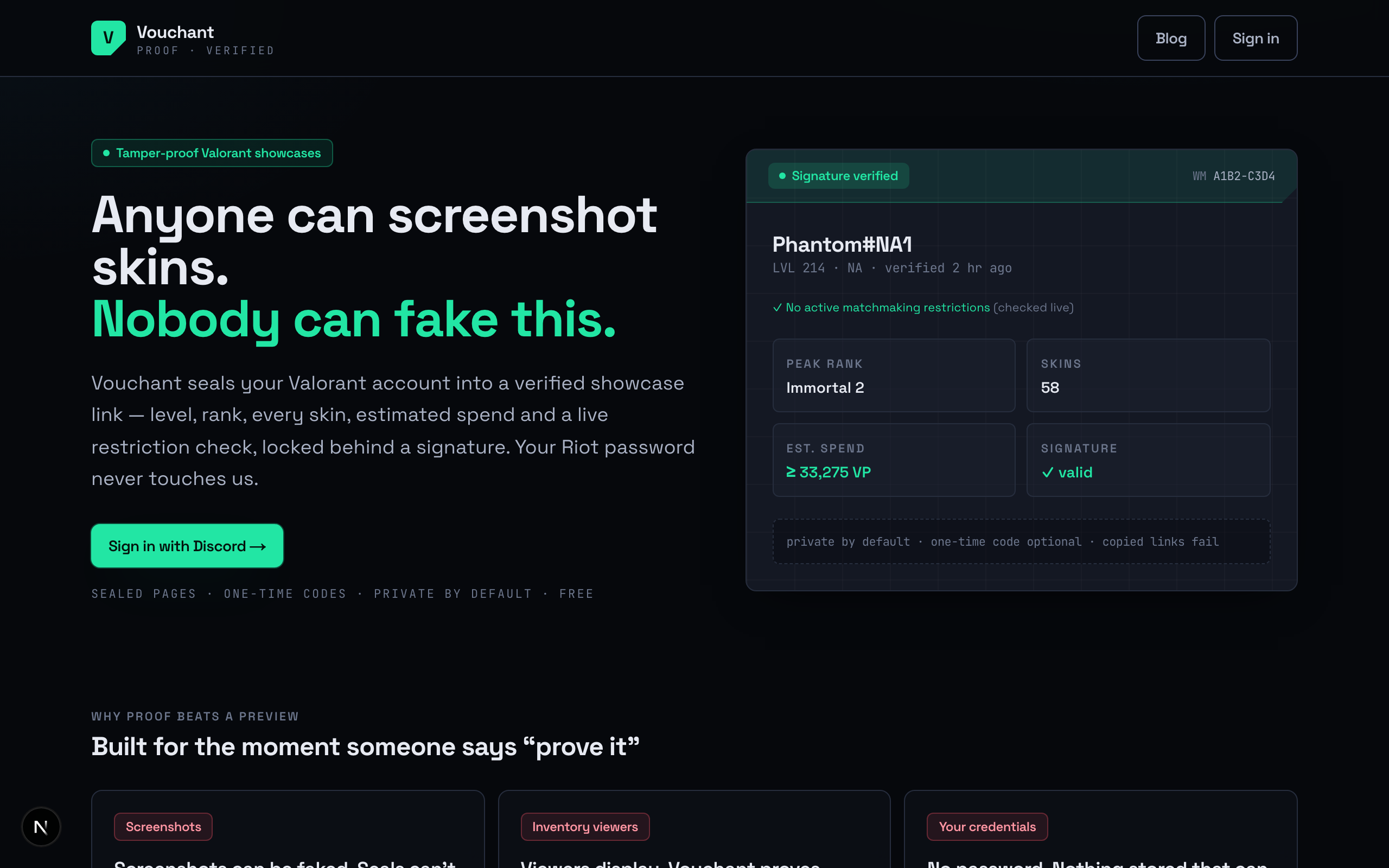
Vouchant turns a Valorant inventory into a verified showcase link instead of another image attachment. You connect through Riot's own login path, Vouchant pulls the collection data needed for the proof, and the final page shows the pieces people usually ask for: level, rank, skins, estimated VP spend, restriction status, and a signature badge. New links are private by default, so you decide when the showcase becomes public. You can also revoke a link if the audience changes, which matters when an old Discord message gets forwarded beyond the original group. The important part is that the viewer is not trusting a manually arranged screenshot; they are looking at a page designed to make tampering visible. For players who already compare collections in Discord, that is the same flex with less doubt and less oversharing.
The bottom line
A Valorant inventory showcase works best when it proves ownership, protects credentials, and stays easy to revoke. Screenshots are fine for casual sharing, but a signed proof page is stronger when the viewer needs confidence. Create a verified showcase at vouchant.space when you want your skins, rank, VP estimate, and restriction status in one link.